TL;DR: If you’re choosing between GPT-5 and the newest rivals, here’s the short version
- GPT-5 is a big step up in AI coding and “agentic” tasks, with state-of-the-art results on real-world coding benchmarks and stronger tool use.
- Claude Opus 4.1 is neck-and-neck on coding accuracy and excellent for large-repo refactors thanks to huge context and precise, file-level edits.
- Gemini 2.x is the most natively multimodal (text + visuals + audio) and pushes agentic features tied to Google’s ecosystem.
- Grok 4 leans into native tool use + real-time internet access, which is great for up-to-the-minute facts and self-verification.
- Llama 3/3.1/4 keep open-source competitive (multilingual, strong coding/math) and are the go-to for on-prem and customization.
What actually changed with GPT-5 (vs GPT-4o)
OpenAI released GPT-5 on August 7, 2025, positioning it as its smartest AI yet: one model that answers fast on easy prompts and thinks deeper on hard ones. For developers, GPT-5 posts SOTA scores on real-world coding (e.g., SWE-bench Verified) and improves tool-calling for end-to-end tasks. It also exposes useful controls like reasoning effort and verbosity. Context limits now reach ~400k tokens total (272k in, 128k out).
If you were waiting for a better model than GPT-4o for everyday software work, this is it. In official benchmarks and internal testing, GPT-5 tends to respond more reliably, write cleaner code, and create more polished UIs from a short prompt. Compared to older models, the difference shows up in fewer retries and more “first-try” passes on things like config files, component files, and test files.
Rollout note: Some teams got early access. OpenAI acknowledged feedback about GPT-5’s cooler tone vs 4o and kept legacy options available. If your team liked 4o’s vibe, you still have access while you evaluate 5.
The 2025 leaderboard (at a glance)
| Model | Release (latest) | Core edge | Multimodal | Context (headline) | Coding sweet spot | Best fit |
|---|---|---|---|---|---|---|
| GPT-5 (OpenAI) | Aug 2025 | SOTA on real-world coding; stronger tool use | Text; (vision/audio via separate tools) | Up to ~400k tokens total | Greenfield builds, tasteful front-ends, agentic workflows | “Default” all-rounder; rapid prototypes that also look good |
| Claude Opus 4.1 (Anthropic) | Aug 2025 | Precise edits; long contexts; agentic | Text+vision variants | Very large windows; 4.1 improves coding to 74.5% SWE-bench Verified | Multi-file debugging, large-repo refactors | Long-context code & docs; surgical fixes |
| Gemini 2.x (Google) | Dec 2024→2025 updates | Native multimodality + “agentic era” integrations | Text+images+audio (and image/audio output) | Large; integrated with Google Search/Workspace | Data+vision coding, research with charts/screens | Multimodal pipelines; GCP shops |
| Grok 4 (xAI) | Jul 2025 | Built-in tool use & live web | Text; tool-augmented | -- | Live data tasks; self-checking code via exec | Up-to-the-minute answers; autonomous info-gathering |
| Llama 3/3.1/4 (Meta) | 2024 to 2025 | Open weights; strong multilingual & coding/math | Text (multimodal variants emerging) | Scales from small to 405B; on-prem possible | Private repos, customization, cost control | Regulated/air-gapped setups; fine-tuning |
Coding: who wins at which task?
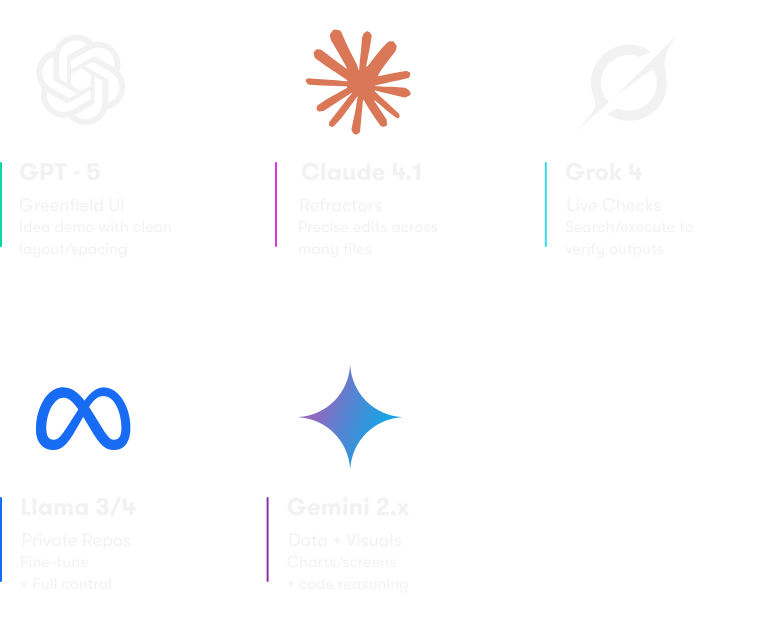
Greenfield builds & “vibe” front-ends → GPT-5
Internal side-by-sides favor GPT-5 for front-end generation (fewer iterations, nicer spacing/typography). It also leads on SWE-bench Verified and Aider polyglot code-editing. Great when you need to create a working app prototype from a short prompt and ship the visible stuff quickly.
Large-repo refactors & precise fixes → Claude Opus 4.1
Claude is praised for pinpoint edits without side effects. That is ideal when you must touch five files and leave fifty other files alone.
Algo/competition or mixed-modality coding → Gemini 2.x
Gemini’s native multimodality and agentic tooling make it a strong pick for data-and-visual workflows or coding that depends on chart/screenshot understanding.
Live data & self-verification → Grok 4
Grok can decide to look things up or run code as part of its reasoning. That helps when correctness improves by verifying results instead of guessing.
On-prem, private repos, customization → Llama 3/3.1/4
Meta’s open models let you control deployment, telemetry, and policy. You can fine-tune on private code and keep everything inside your own environment.
Want hands-on help implementing the winner? KoombeaAI offers AI-First software development and a rapid AI prototyping sprint to ship a working demo fast.
Buyer’s decision tree (read this slowly)
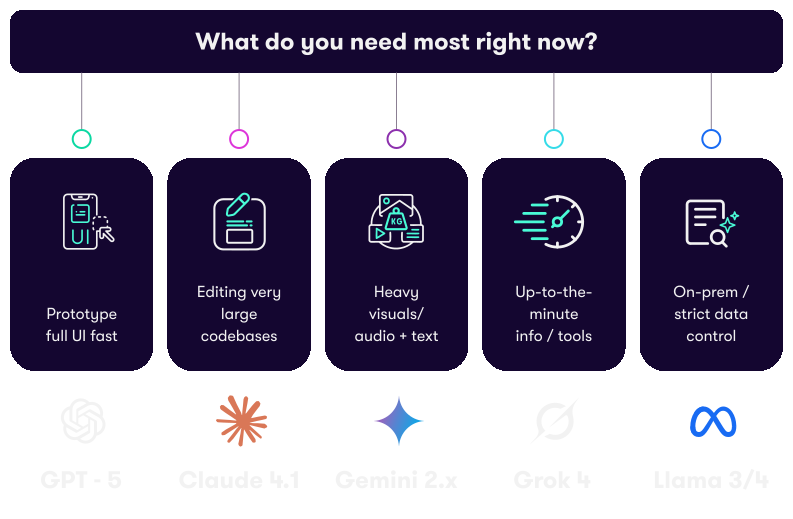
- Need on-prem or strict data control? → Start with Llama 3.1/4, fine-tune your repos.
- Editing/understanding very large codebases? → Claude Opus 4.1.
- Prototype full UI fast (with decent “taste” out of the box)? → GPT-5.
- Heavy visuals/audio + text in one loop? → Gemini 2.x.
- Up-to-the-minute info or autonomous tools? → Grok 4.
- Still torn? → Run a 5-task bake-off (UI build, refactor, data+chart Q, research summary, policy-sensitive prompt) and pick one model as your daily driver + one specialist.